


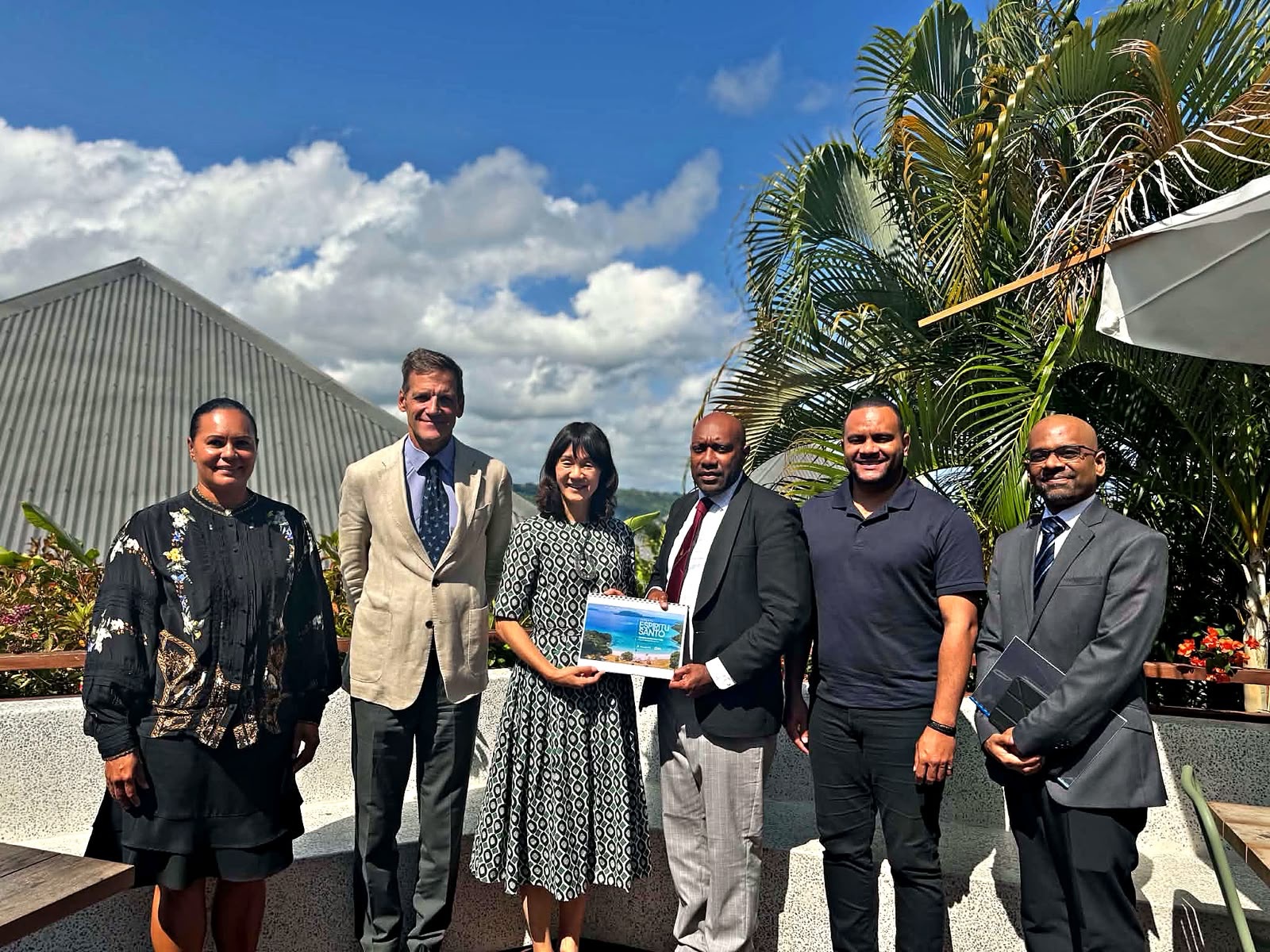
Friday, 2 nd October 2026 – Port Vila, Vanuatu : The Department of Tourism (DOT) of the Ministry of Trade and Commerce (MTC) has received the Espiritu Santo Vanuatu Investor Information Document 2026 from the International Finance Corporation (IFC), handed over on Thursday 17 September 2026 at Mangoes Restaurant in Port Vila. The document presents six investment-ready tourism sites on and around Espiritu Santo to international investors, and is the first publication of its kind produced for a single Vanuatu destination.
The handover was made by Ms. Keiko Miwa, IFC Division Director for East Asia and the Pacific, during her official visit to Vanuatu on 17 and 18 September 2026. Ms. Miwa oversees IFC's work across Indonesia, Cambodia, Lao PDR, Myanmar, the Pacific Islands, Papua New Guinea and Timor-Leste. She was accompanied by Mr. Bernard Harborne, IFC Joint Country Representative for Vanuatu and Solomon Islands; Mr. Shihab Azhar, Senior Operations officer, Country Advisory and Economics; and Ms. Liz Pechan, IFC Vanuatu Country Officer. The document was received on behalf of the Government of Vanuatu by the Director General of the Ministry of Trade and Commerce, Mr. Noah Patrick Kouback, witnessed by the Director of the Department of Tourism, Mr. Paul Pio.
A joint piece of work
The objective of the programme is to identify and promote investment-ready tourism opportunities that support sustainable tourism growth and increase private sector participation in the tourism economy. Espiritu Santo was selected as the starting point as the country's second international gateway and the destination with the widest gap between its natural assets and its current accommodation base.
The Investor Information Document was prepared by IFC in conjunction with the Tourism Investment Division of the Department of Tourism, working alongside the Vanuatu Foreign Investment and Promotions Authority (VFIPA) and industry stakeholders. The Tourism Investment Division carried the Government's side of the work throughout, from reviewing the deliverables from the outset.
The technical assessment ranked and profiled candidate sites against a number of factors critical for investors: accessibility, natural assets, tenure, servicing and development potential. That assessment is what distinguishes this publication from general destination promotion: each site is presented with a defined land area, a described means of access, the status of its leasehold arrangements and an indicative development concept that the site can realistically support.
Clear land tenure and a credible offer
The analysis identified several highly competitive sites in Espiritu Santo that are ready for investment in the short to medium term. Every site listed in the document has established leasehold arrangements that are officially registered. The existing lease structures provide a clear framework for investment and development, the process for lease transfer is well established, and the market is supported by experienced local legal and real estate professionals. For investors weighing Vanuatu against other Pacific destinations, this certainty of tenure is among the strongest features of the offer.
Espiritu Santo itself holds internationally recognised natural assets, including Champagne Beach, freshwater blue holes, extensive coral reef systems and the SS President Coolidge, one of the world's most celebrated wreck dives. Santo-Pekoa International Airport provides direct international access and serves as the gateway to northern Vanuatu, supported by domestic air and maritime connections that make the island accessible directly from Australia and New Zealand and indirectly from the United States, Europe and other Pacific markets.
Compared with many Pacific destinations, Santo remains significantly under-developed from a tourism perspective. The absence of any internationally branded accommodation on the island creates a clear first-mover advantage for investors prepared to establish market-leading products as the destination matures, at a time when global travel demand is moving towards authenticity, sustainability, cultural immersion and nature-based experiences — the qualities on which Santo already trades.
Tourism investment and the national economy
Tourism remains a cornerstone of the national economy, contributing substantially to gross domestic product, employment and foreign exchange earnings. The sector accounts for 57% of the gross domestic product generated by services and 46% of services employment. Australia remains the dominant source market, followed by Europe, New Zealand and China, with holiday travel accounting for the large majority of visitor arrivals and demand concentrated between April and September. Investment of the kind set out in this document is central to distributing the benefits of tourism beyond Efate and to strengthening Espiritu Santo as the country's second tourism gateway. New and expanded accommodation on Santo supports airline load factors on the Santo-Pekoa routes, creates employment in SANMA Province, and widens the market for the agricultural producers, tour operators, transport providers and handicraft producers who supply the visitor economy in the north.
Next steps
“IFC's role is to help create the conditions for private investment that delivers jobs and opportunity for ni-Vanuatu communities, and we look forward to continuing that work with the Government of Vanuatu”, the IFC Division Director for East Asia and the Pacific, Ms. Keiko Miwa, said. “Espiritu Santo
holds natural assets that few destinations in the region can match. We have identified several sites on Espiritu Santo which are ready for investment today that could be of interest to investors if they can be provided with the right information and coordinated promotion and facilitation”. We look forward to working with the Department of Tourism to take these opportunities to investors and support the Government into converting these opportunities into investments.”
Responding for the Department of Tourism, the Director, Mr. Paul Pio, said the Department supports the work undertaken and the process that produced it.
“Espiritu Santo is the starting point, not the finish. We are also looking at other islands to identify sites that could be brought to the same standard of
readiness”, he said.
“That is not a simple exercise. Disputes over land ownership remain one of the main obstacles to presenting a credible list of investable tourism sites, and they have to be resolved before any site can be offered to an investor. The Department will work through those questions island by island, together with the Vanuatu Foreign Investment and Promotions Authority and the Department of Lands, before we publish a further list”.
The Department will now work with VFIPA, IFC and the site holders to take the document to market. The Tourism Investment Division will serve as the Government's focal point for investor enquiries, site facilitation and coordination with other agencies, and will ensure that proposals arising from the portfolio are consistent with the Vanuatu Sustainable Tourism Policy 2030 and deliver lasting benefits for Santo's communities and customary landowners.